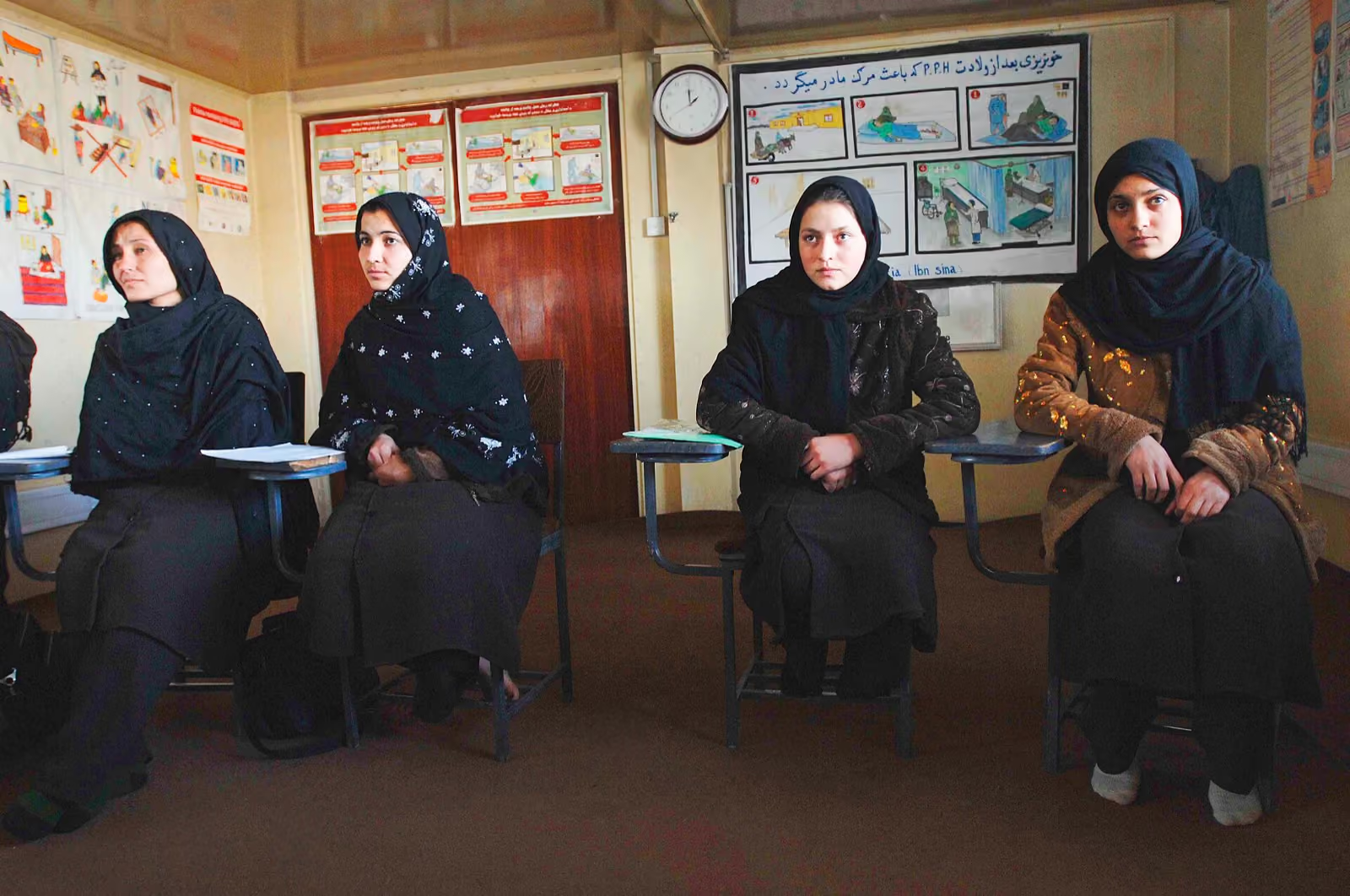
Free medical handbooks today, and a plan to train many more women doctors and midwives in emergency obstetrics.
Photo: Fred W. Baker III / Wikimedia Commons, public domain
Overview
MCAI in Afghanistan: Supporting emergency maternal and newborn healthcare
MCAI is working to explore practical ways of strengthening emergency hospital care for pregnant women and babies in Afghanistan, with particular attention to the needs of rural communities. Our work has included donating medical training books for doctors, nurses and midwives, and developing proposals for further training in advanced emergency obstetric care.
This work requires careful consideration of Afghanistan’s cultural, religious and healthcare context. MCAI aims to develop approaches that are respectful of local practices and requirements, while helping women healthcare professionals gain access to the knowledge and training needed to provide essential care. We are currently in communication with the Ministry of Health in Kabul about a proposed training programme.
Programme 1 of 4
Medical training books for doctors, nurses and midwives
In 2022, MCAI donated 1,000 medical training books to support hospital-based care in Afghanistan. The books covered:
Obstetrics: 250 books
Neonatal care: 250 books
Paediatrics: 500 books across two volumes
The books were intended to support doctors, nurses and midwives in developing their knowledge and skills in caring for pregnant women, newborn babies and children.
Developing a training programme in advanced emergency obstetric care
MCAI has developed a proposed plan to strengthen emergency hospital-level obstetric care, particularly in rural areas where access to suitably trained staff can be limited. Communications with the Ministry of Health in Kabul are currently underway.
The proposal recognises that much advanced obstetric care involves medical management rather than surgery. It therefore suggests a combined approach: carefully managed online training for medical aspects of emergency obstetrics, supported by practical, on-the-ground training in surgical procedures. Practical training would be led by international or national female obstetricians, with female nurse anaesthetists also needed to support surgical care.
The proposal highlights the potential to expand the number of female doctors able to provide advanced obstetric care. Data from the Royal Tropical Institute and WHO (2025) indicate that around 27% of the 6,045 non-specialist doctors working in Afghanistan’s public sector are women. This represents approximately 1,632 female doctors who could potentially benefit from further training, alongside the 277 currently providing this essential service.
A particular priority is to help rural provincial hospitals have access to qualified female doctors or midwives able to undertake life-saving emergency procedures.
Making training accessible and appropriate to the local context
For the programme to work, training materials would need to be available in both Pashto and Dari, in printed and electronic formats. MCAI’s existing training handbook and other teaching resources would be translated to support trainees and trainers.
The proposed programme would also require reliable, appropriately regulated internet access for online learning, together with tablets or computers containing teaching materials, videos, presentations, secure examinations and individual training logbooks.
MCAI recognises that successful implementation depends on working in ways that are appropriate to Afghanistan’s religious, cultural and professional context. The proposed training for female doctors and senior midwives would therefore need to be carefully planned in consultation with relevant Afghan authorities and healthcare partners. This includes considering suitable arrangements for teaching, practical training and professional supervision, so that the programme can be delivered respectfully and effectively.
MCAI’s approach is to work constructively with Afghan healthcare authorities and local professionals to identify what is practical, acceptable and sustainable. The proposed programme is still under development, and discussions with the Ministry of Health are ongoing.
By combining accessible learning resources with appropriately organised practical training, MCAI hopes to help strengthen the skills available within Afghanistan’s hospitals and improve access to emergency care for women and babies, particularly in rural communities.